Did you know that you can build a rocket with a balloon, straw, some yarn, and two chairs? Read on to learn more about how to make this fun end-of-year classroom activity: balloon rocket race with teacher, Taylor Blair.
End-of-Year Classroom Activity: Balloon Rocket Race Instructions
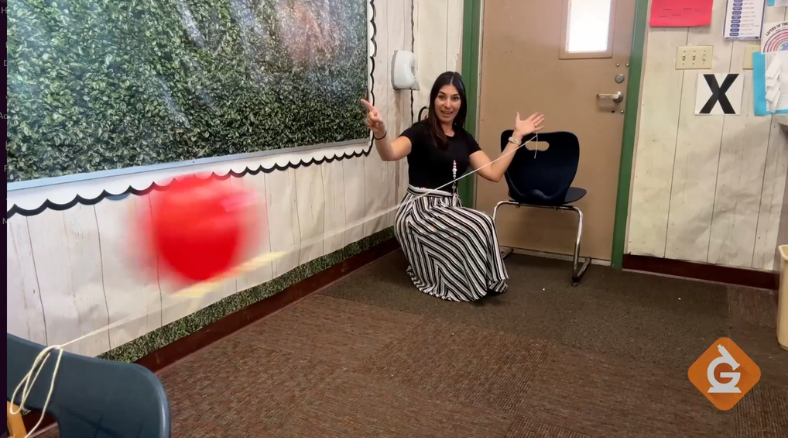
Today, we’re building a rocket with Taylor Blair (teachmesomethingood) out of a few simple materials to show potential energy and kinetic energy.
- Set your chairs about 10-15 feet apart. And put the string from chair to chair. And the tighter it is, the smoother our rocket ship is going to fly.
- Place the string through the straw.
- Tie the string from one chair to the next as tight as you can, because that’s going to allow us the smoothest travel for our rocket.
- Blow up your balloon and tape it to your straw.
Science talk with Taylor: Potential Big Energy
Before we get into the actual rocket, let’s talk science.
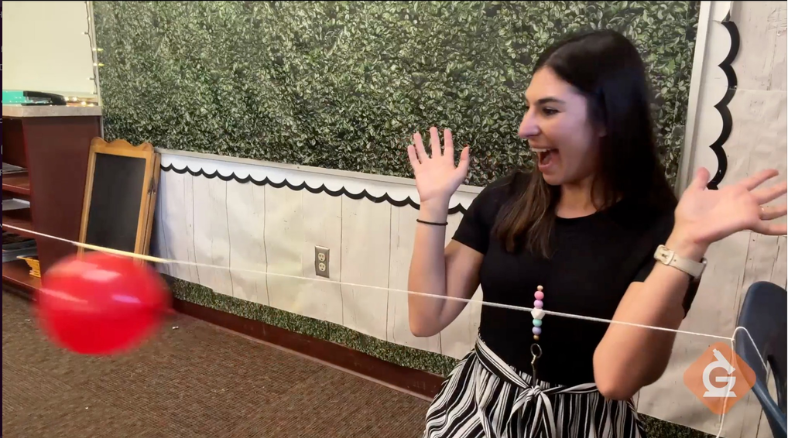
You’re going to be blowing air into this balloon. This is going to create energy. Because this air is blowing up. This elastic balloon is getting so tight that it wants to release, but it doesn’t yet. So this is why it’s called a potential energy, because it has the potential to be some big energy. This is forcing air into the balloon.
Now it’s storing potential energy. Its potential because it’s not going anywhere. It’s actually waiting to be released. And then it’s put into motion because this elastic is stretched out and it just wants to collapse so badly, but it can’t yet.
Once the balloon is in motion, it immediately turns to kinetic energy.
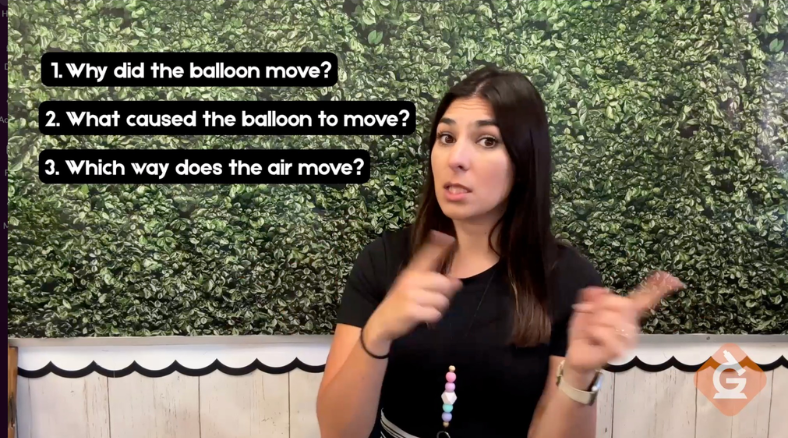
Put your science caps on. Here’s some questions:
1: Why did the balloon move?
2. What caused the balloon to move?
3. If the balloon was moving this way, which way did the air and the balloon move?
The balloon moved because when we filled the balloon with the air from our lungs, this ended up storing potential energy.
The farther along it goes on the string, it runs out of energy and slowly it just stops. This is because we’re running out of energy. This balloon only has the amount of energy that I blew into it.
This is Newton’s Third Law of Motion : which means for every action there is an opposite, an equal reaction.
The amount of air that we’re blowing into this balloon is going to have the equal amount of energy, but the opposite reaction. So, the air shoots backwards out of the balloon. This results in an action and a reaction. Also, the balloon shoots forward on our string. Both are going to be equal. Whatever air is put into this balloon, is what you’re going to get out of it.
For more on energy, check out Potential Vs. Kinetic Energy (6-8)
End-of-Year Classroom Activity: Balloon Rocket Race (What Did We Learn)
Balloons can store potential energy, but as soon as we let it go and the air is released, it immediately turns into kinetic energy. All because we have movement forces or what caused the motion. As we lose force, the friction of the string and the straw gets stronger, also causing the balloon to come to a stop.
And the coolest part? Real rockets use the same basic science, just with a lot more power. So where else do you think you can find potential and kinetic energy? It’s not just in rockets. Science is everywhere.
For more DIY activities, check out How to Make an Unpoppable Bubble DIY Activity



 GENERATION GENIUS