Fireworks are usually bright and loud. But, what if we can make a firework without it being loud, bright, or dangerous? Read on to learn more from teacher Taylor Blair, on how to make fireworks in a jar DIY activity.
Fireworks in a Jar : What You Need
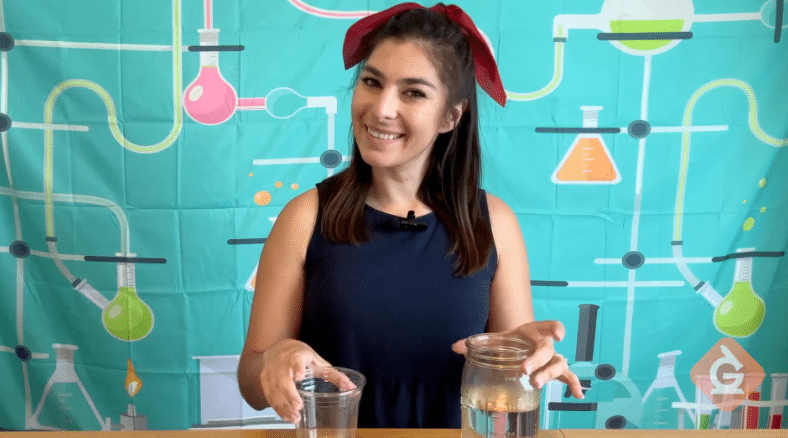
Today’s science DIY activity requires just a few simple steps and some kitchen items.
Supplies:
•Warm vegetable oil
•Food coloring (a few different colors)
•Jar
•Warm water
•Fork / Straw / or Toothpick
Warm Water Vs. Cold Water
So, we should fill our jar about three quarters full with warm water.
Why warm water?
We’re using warm water because warm water molecules move faster. Meaning, when the food coloring hits the water, it’s going to disperse quicker, making the explosion like a pattern.
Now you can do this with cold water, but it’s going to affect the outcome of the fireworks. In cold water, the food coloring tends to sink to the bottom. The explosions are a little bit slower, making it less dramatic and less explosive. This is going to be the stage where our fireworks take place.
Next, we create our color mixture. So, you’re going to need a regular cup and some vegetable oil. Also, add a couple drops of food color and stir slowly.
But, you don’t want to mix all the colors. You want the colors to stay separate. We’re actually trying to trap tiny pockets of color inside the oil.That way, they’re not all sinking at the bottom.So what we’re doing is creating tiny droplets, like color capsules, waiting to be released.
Fireworks in a Jar DIY Activity: Scientific Questions
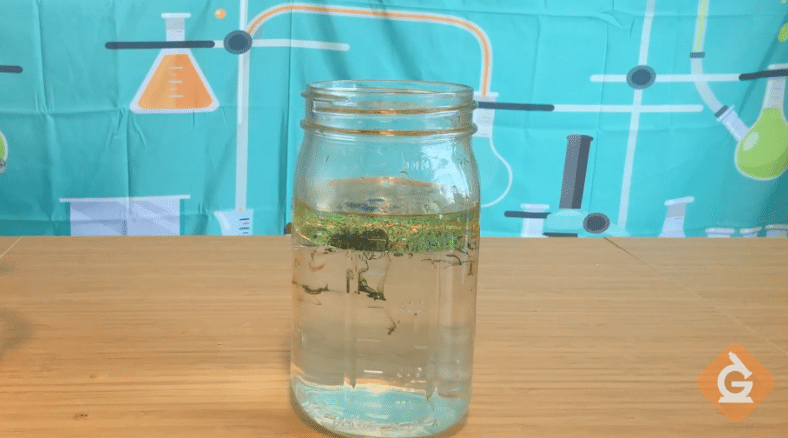
•What will happen when the oil and water meet?
•Will the colors float?
•Will they sink?
•Will they disappear instantly?
This is important because this is what scientists do every time they do a science activity or an experiment.
•Make predictions
•Test the activity / experiment
•Find the results.
Fireworks in a Jar DIY Activity: Observations
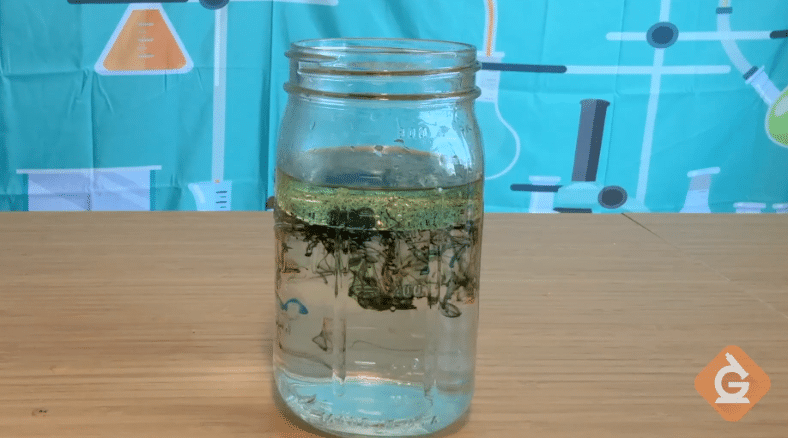
Now, the oil is rising at the top. That’s to be expected.They’re separating and breaking apart.
Some are starting to fall downward. So now it’s happening. Watch those bursts of colors spreading through the water. They look like underwater fireworks, exploding in slow motion.
But nothing’s exploding or burning. It just looks that way because of how the colors spread.
What’s actually happening here?
- Density
We can distinctly see two layers.Oil is less dense than water, so it rises to the top. Always going to create a layer. Oil and water do not mix.
- Solubility
Food coloring is water based, not oil based. That’s why when we’re putting drops of food coloring in our cup of oil, it’s not just mixing. They’re little droplets. That’s why as soon as it hits the water, it doesn’t want to stay with the oil. Because the food coloring is water based, it wants to go and blend with the water.
- Diffusion
Once the food coloring hits the water, it spreads out in all directions, and that spreading is what makes the firework effect. This same process happens all around us. When the drop dye goes into water, the way sugar dissolves in coffee, when ink spreads on a paper towel, and even inside your body, nutrients going through cells use the same thing.
So maybe we didn’t create “real” fireworks, but we did use science to create something that looked pretty magical. And it all happened because of density, solubility, and diffusion. And honestly, that might be even cooler. Because science is everywhere.
For more DIY activities, check out Rainbow Walking Water DIY Activity


 GENERATION GENIUS